
Raspberry Pi - Potentiometer Piezo Buzzer
Deze tutorial begeleidt u bij het gebruik van de Raspberry Pi en een potentiometer om een piezo buzzer aan te sturen. In detail:
- De Raspberry Pi bepaalt of de analoge waarde van de potentiometer boven of onder een drempel ligt, en maakt geluid op basis daarvan
- De Raspberry Pi bepaalt of de uitgangsspanning van de potentiometer boven of onder een drempel ligt, en maakt geluid op basis daarvan
- Als de uitgangsspanning van de potentiometer groter is dan een drempelwaarde, kan de Raspberry Pi ook een melodie afspelen
Hardware Benodigd
Of u kunt de volgende kits kopen:
| 1 | × | DIYables Sensorkit (18 sensoren/displays) |
Over Piezo Buzzer en Potentiometer
Als u niet bekend bent met piezo buzzer en potentiometer (inclusief pinout, werking en programmeren), kunnen de volgende tutorials u helpen:
Bedradingsschema
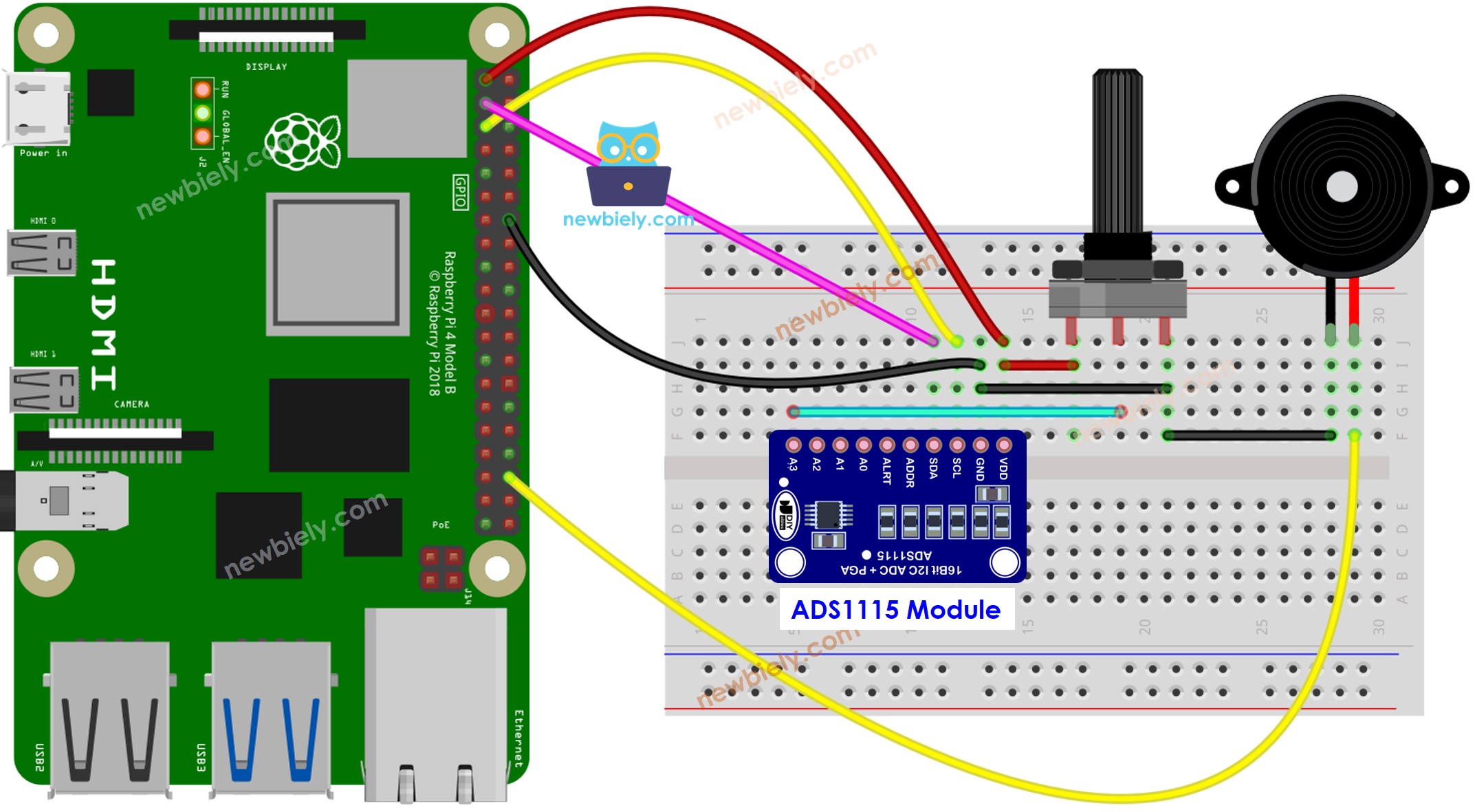
Deze afbeelding is gemaakt met Fritzing. Klik om de afbeelding te vergroten.
Raspberry Pi Code - Simpel Geluid
Snelle Stappen
- Zorg dat u Raspbian of een ander Raspberry Pi compatibel besturingssysteem op uw Pi heeft geïnstalleerd.
- Zorg dat uw Raspberry Pi verbonden is met hetzelfde lokale netwerk als uw pc.
- Zorg dat uw Raspberry Pi verbonden is met internet als u bibliotheken moet installeren.
- Als dit de eerste keer is dat u de Raspberry Pi gebruikt, bekijk dan hoe u de Raspberry Pi instelt.
- Verbind uw pc met de Raspberry Pi via SSH met de ingebouwde SSH-client op Linux en macOS, of PuTTY op Windows. Zie hoe u uw pc verbindt met Raspberry Pi via SSH.
- Controleer of de RPi.GPIO bibliotheek geïnstalleerd is. Zo niet, installeer deze dan met het volgende commando:
- Installeer de Adafruit_ADS1x15 bibliotheek door het volgende commando uit te voeren in de terminal van uw Raspberry Pi:
- Maak een Python-scriptbestand aan met de naam potentiometer_buzzer.py en voeg de volgende code toe:
- Sla het bestand op en start het Python-script door het volgende commando in de terminal uit te voeren:
- Draai aan de knop van de potentiometer.
- Luister naar het geluid afkomstig van de piezo buzzer.
Het script draait in een oneindige lus, totdat u Ctrl + C indrukt in de terminal.
Code-uitleg
Bekijk de regel-voor-regel uitleg in de commentaren van de broncode!
Raspberry Pi speelt de melodie van het liedje
Laten we de melodie van "Jingle Bells" spelen wanneer de potentiometer wordt gedraaid tot voorbij een drempelwaarde.
Snelle Stappen
- Maak een Python-scriptbestand aan met de naam potentiometer_buzzer_song.py en voeg de volgende code toe:
- Sla het bestand op en start het Python-script door het volgende commando in de terminal uit te voeren:
- Draai aan de potentiometer.
- Hoor het liedje uit de piezo buzzer komen.
Code-uitleg
Bekijk de regel-voor-regel uitleg in de commentaren van de broncode!
Video Tutorial
We overwegen het maken van videotutorials. Als u videotutorials belangrijk vindt, abonneer u dan op ons YouTube-kanaal om ons te motiveren de video's te maken.
Gerelateerde Tutorials
📱 Aanbevolen apps
 English for KidsSpelenderwijs Engels leren voor jonge kinderen.Ontdek het opGoogle PlayBeschikbaar in deApp Store
 Bubble NoteZelfverwijderende notities – schrijf ze als berichten.Ontdek het opGoogle PlayBeschikbaar in deApp Store
 Didn't BuyVersla impulsaankopen en bespaar meer.Ontdek het opGoogle PlayBeschikbaar in deApp Store
 Knowledge PathOefentoetsen om alles te leren.Ontdek het opGoogle PlayBeschikbaar in deApp Store